Supplements and Brain Health: What to Know
Supplements and Brain Health: What Emerging Research Means for You
A daily supplement can feel like a straightforward investment in your future health. But the relationship between supplements and brain health is more complicated than a bottle’s promises suggest. Whether a supplement helps depends on the person taking it, the reason for using it, and the evidence supporting that decision.
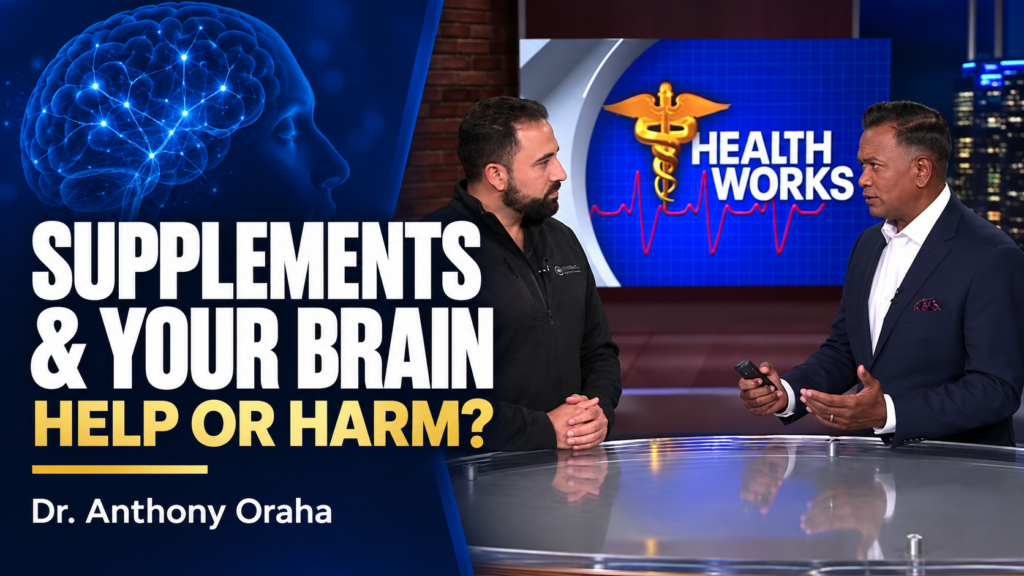
I recently joined Roop Raj on FOX 2 Detroit to discuss emerging research involving vitamin D, fish oil, and glucosamine. The findings raise worthwhile questions. They do not establish that these supplements cause dementia.
Watch the full FOX 2 Detroit conversation.
Supplements and brain health: what the studies actually show
Three recent investigations have drawn attention to possible associations between supplement use and cognitive outcomes.
Vitamin D: A study of 5,065 adults followed over six years found slightly faster declines in cognitive scores among supplement users. In a subgroup analysis, the association appeared among people with adequate vitamin D levels, rather than those with insufficient or deficient levels. This does not establish that vitamin D caused the decline. It does challenge the assumption that taking additional vitamin D when you already have enough will protect your memory.
Fish oil: Another observational analysis linked omega-3 supplementation with faster cognitive decline. Researchers proposed changes in brain energy metabolism as one possible explanation, but the mechanism remains uncertain. The broader research is mixed, and findings about eating seafood cannot automatically be applied to fish-oil capsules.
Glucosamine: Researchers combined laboratory experiments with an analysis of human medical records. Glucosamine worsened memory-related performance in an Alzheimer’s mouse model. In human records, its use was associated with greater progression from mild cognitive impairment to dementia. This raises a question about vulnerable populations; it does not demonstrate that glucosamine causes dementia in healthy adults.
These studies offer reasons for further investigation. None provides a basis for telling everyone to stop taking supplements.
Why an association is not proof of harm
Observational research follows what happens to people without randomly assigning their treatment. That makes it useful for identifying patterns, but less reliable for determining what caused them.
People who take supplements may differ from those who do not in their health conditions, medications, diet, or reasons for seeking treatment. Some may begin a supplement because they are already noticing memory changes. Researchers can adjust for measured differences, but important factors may remain unaccounted for.
Similarly, an experiment in mice can help explain a biological mechanism without proving the same effect occurs in humans at typical doses.
The distinction matters in both directions: we should not dismiss a possible safety signal, and we should not turn it into a certainty.
Glucosamine: a joint supplement with effects beyond the joints
Glucosamine is an amino sugar involved in pathways that help the body build and modify important molecules. Its derivatives contribute to cartilage and other connective tissues. They also participate in glycosylation—the normal process of attaching sugar structures to proteins.
People commonly take glucosamine sulfate or glucosamine hydrochloride for osteoarthritis symptoms, often alongside chondroitin. However, research on pain relief has produced inconsistent results, and rebuilding cartilage is not an established benefit.
The newer brain study examined whether glucosamine could feed an already abnormal glycosylation pathway in Alzheimer’s disease. This is different from simply saying that dietary sugar causes dementia.
The practical question is whether an individual’s supplement provides enough benefit to justify continued use, particularly when cognitive impairment or medication interactions are concerns.
A more thoughtful approach to supplements
Every supplement should have a clear purpose. Correcting a deficiency is different from taking additional nutrients in the hope of preventing future disease.
Bring your supplement bottles—or photographs of their labels—to a physician or pharmacist and ask:
- What problem is this intended to address?
- Is there evidence of benefit for someone with my health history?
- Am I duplicating ingredients across several products?
- Could it interact with my medications?
- How will we decide whether I still need it?
Do not discontinue a prescribed treatment based on a headline. Prescription omega-3 products used for specific lipid conditions, for example, are not interchangeable with supplements purchased for memory support.
Keep attention on the foundations of cognitive health: physical activity, blood-pressure management, nutritious food, adequate sleep, and social connection.
At Synergy Longevity Centers in Novi, Michigan, our approach begins with understanding your health, your risks, and the purpose behind each recommendation. A supplement plan should be reassessed as those factors change.
To discuss how your supplements fit into your broader preventive health plan, learn more about Synergy Longevity Centers.
Common questions
Do these studies prove supplements cause dementia?
No. The human findings identify associations. They cannot establish that the supplements caused cognitive decline or dementia.
Should I stop taking vitamin D if my level is normal?
A normal level alone does not answer whether supplementation remains appropriate; it may reflect your current treatment. Review the original indication and dose with your clinician.
Does glucosamine rebuild cartilage?
Cartilage regeneration is not an established benefit. Research on relief of osteoarthritis symptoms is inconsistent.
This article is for general education and does not replace individualized medical advice.
By Anthony Oraha, MD